
Table of Content
Yoga Studio Management: What Owners Need to Track Weekly to Find the Best Yoga Studio Software for Your Business
Most yoga studio owners check their bank balance more often than they check their numbers. By the time a slow month shows up in the account, the problem has been compounding for six to eight weeks. Class attendance has drifted. A handful of members quietly stopped coming. The Tuesday 7am yoga class lost its regulars. None of it was visible until it was already a revenue dent.
Weekly tracking is the difference between running a yoga studio and reacting to one. It does not require a finance background or a complicated spreadsheet. It needs five fitness business metrics, a thirty-minute ritual, and a solid platform pulling the data into one place. This piece is a practical framework for what to track, why it matters, and how to choose a yoga studio management platform that actually surfaces what you need to make as a studio owner the calls that matter. The aim is to help yoga studios spot drift early, run leaner, and protect the experience inside the room.
Why weekly tracking beats monthly reviews for yoga studios
Monthly reviews are too late, and most yoga studios discover this the hard way. A boutique studio operates on tight margins, with most owners running at a 10-20% net profit once rent, payroll, and software costs are accounted for. A two-week dip you spot in week six has already cost you a thousand dollars or more, and by then the behavioural pattern is set. Members who skip three weeks rarely come back without a deliberate nudge. The best software for catching this drift early sits on a weekly cadence, not a monthly one.
Weekly tracking catches drift while it is still small. It also forces you to look at the same numbers in the same order every week, which is how patterns become obvious. The Wednesday 6pm yoga class is down 15% for three weeks running. New intro offer signups dropped the week your Instagram posting slowed. Two long-term members went quiet at the same time. None of these are visible in a monthly summary, but they are obvious on a weekly dashboard pulled from your booking software. Strong booking flows feed clean data, and clean data is what makes the weekly habit possible.
The other reason weekly beats monthly: it makes you a better operator. You stop running on vibes and start running on data. The owners who scale to multiple yoga studios, or who simply build a sustainable single-location yoga business, are almost always the ones who developed a weekly review habit early. The right software is what makes the habit stick.

The five fitness business metrics every yoga studio owner should check weekly
You do not need fifteen metrics. You need five, tracked consistently, with the discipline to act on them. Each metric below should sit on the front page of whatever yoga studio management software you use.
Class attendance and capacity rate
This is the single most important number in your studio. Capacity rate is the number of bookings divided by the total spots available across all your classes in a week. A healthy boutique studio runs at 65-80% capacity overall, with peak classes (weekday evenings, Saturday mornings) hitting 85-95% and off-peak slots sitting at 40-60%.
Track this weekly by class, by day, and by instructor. The pattern you are looking for is consistency. A 70% average masks a lot if half your classes are at 95% and the other half at 40%. The classes consistently below 50% are telling you something: wrong time, wrong format, wrong instructor for that slot, or a marketing gap. Yoga studio scheduling software built for class formats (rather than gym slots) will surface this view automatically if you have it set up correctly. Tools designed specifically for yoga studios tend to cluster the data in a way that makes drift obvious at a glance.
New client conversion rate
How many people who buy your intro offer convert to a paid membership or pack within 30 days of expiry? In a healthy boutique studio, this number sits at 35-50%. Below 30% means your intro experience, your follow-up sequence, or your offer structure is broken.
Track this every week. Pull the list of intro offers expiring in the next 7 days and the list that expired in the last 30. Of the expired ones, how many converted? Of the upcoming, who has come more than four times (high intent) versus once or twice (likely to lapse without a nudge)? This single weekly check, paired with a simple email or call to high-intent intros, can lift your conversion rate by 10-15 percentage points within a quarter.

Member retention and membership churn
Monthly churn for a healthy boutique studio sits at 4-7% of your active membership base. At 8% you are leaking members faster than most yoga studios can replace them. At 10% or above you have a structural problem, usually around onboarding, class quality, or community. Strong retention practices, paired with the right client tracking inside your platform, are the difference between 5% and 10% churn.
Weekly, you want two views. First, who cancelled this week and why (a good platform will let you tag a reason). Second, which active membership holders have not booked in the last 14 days. The second list is your early warning system. A member who used to come three times a week and has not booked in two weeks is not "just busy." They are 70% on their way out the door. A personal message from the studio owner at week two saves more memberships than any retention email sequence.
Revenue per available class hour
Borrowed from hospitality, where it is called RevPAR (revenue per available room), this number tells you how much each hour of class time on your schedule actually earns. The formula is simple: total weekly revenue from classes divided by total scheduled class hours.
A studio teaching 40 hours of class a week and pulling $4,000 in class revenue is at $100 per available class hour. The number itself matters less than the trend. If your hours stay flat but the per-hour figure drops, you have either an attendance problem or a pricing problem. If you are adding classes and the per-hour figure drops faster than your bookings can keep up, you are over-scheduled. This is one of the most underused fitness business metrics in the industry, and it surfaces decisions that pure attendance numbers hide.
Instructor performance
Track three things per instructor weekly: average attendance per class, member feedback (a simple thumbs up or written comment in your booking software counts), and no-show or late-cancel rates from their classes. Your strongest yoga instructors will have higher attendance and lower no-show rates because members commit harder to teachers they value. The most successful yoga studios protect their best teachers by giving them prime slots and watching the data to confirm those slots stay strong.
This is not about ranking instructors against each other. It is about spotting when a teacher who used to fill a class is suddenly not, or when a new hire is converting better than expected and deserves a better time slot. Yoga studios that grow well treat instructor data as scheduling intel, not as a performance review tool.
What to look for in yoga studio software: management features that earn their fee
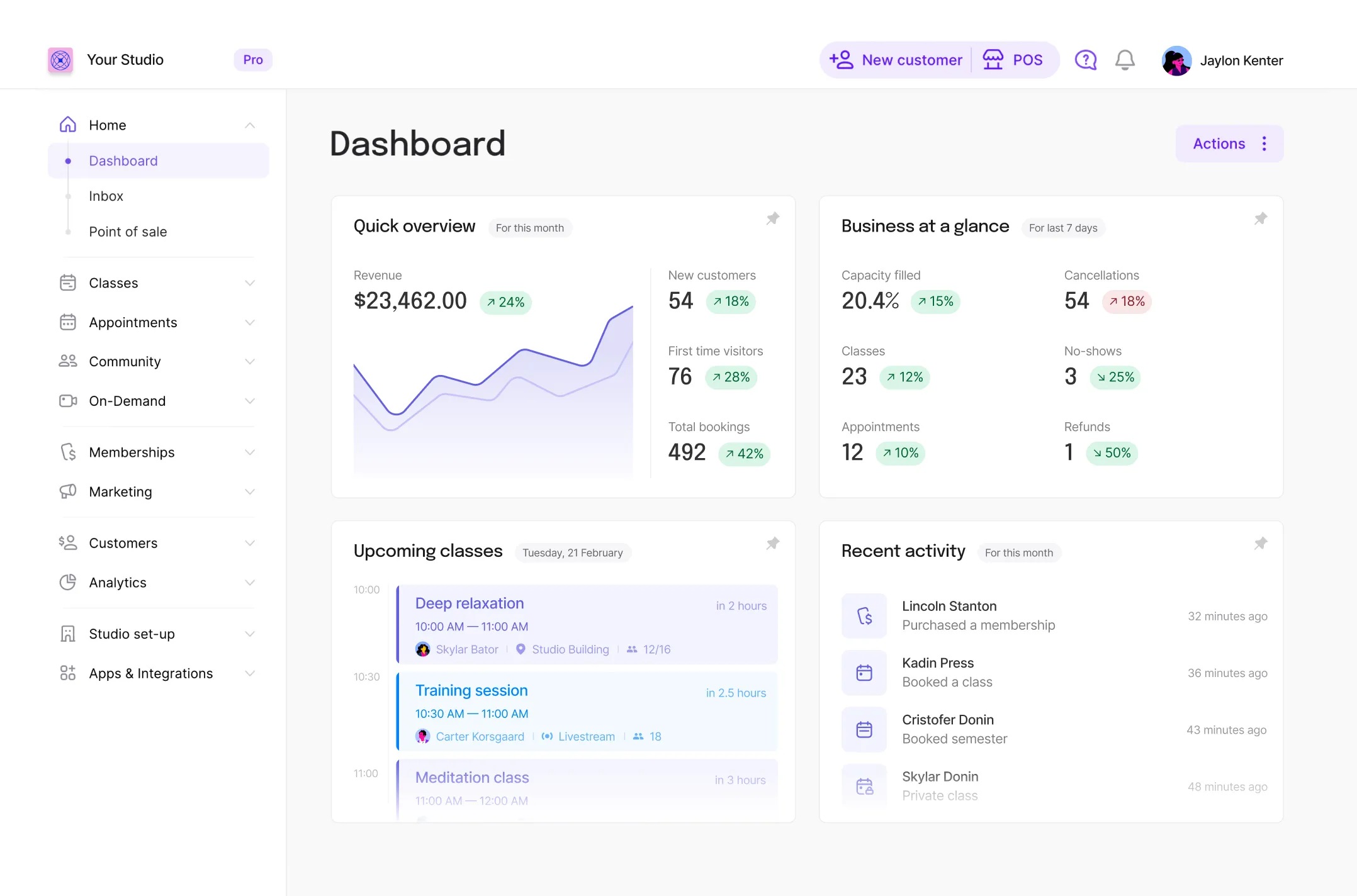
A good platform combines all of the above into one view. If you are pulling numbers from three different systems every Monday, you will stop doing it within a month. The whole point of an all-in-one yoga studio management software is that the data flows in automatically and the weekly review becomes a fifteen-minute glance, not a ninety-minute reconciliation. Strong yoga studio management software can streamline operator workload by 70% or more, freeing studio owners to focus on teaching, hiring, and community.
When you are evaluating your yoga studio software options, here is what matters:
- Class management and online booking in one place, with waitlists, late-cancel policies, and class schedule changes that update across web and mobile app instantly. Good class booking flows are short, friction-free, and mobile-first. Studio booking experiences should match the cleanliness of the studio itself.
- Member management plus client management tools that show lifetime value, attendance history, and last booked date at a glance. This is your retention early warning system.
- Reporting you can read in under thirty seconds. Capacity rate, conversion rate, churn, and revenue per class hour should be visible without running a custom report. The best management tools surface these without effort.
- A branded app if you have over 200 active members. Members who book through a dedicated app book 40% more often than members using a generic platform, because the friction is lower and the studio is on their home screen. A mobile app also strengthens your yoga community, because members open it more than email.
- Class and appointment management in one system. If you offer privates, workshops, or therapy sessions alongside group classes, your scheduling software should handle both without duct tape.
- Integrations with email and SMS so retention nudges and intro offer follow-ups can be automated without leaving the platform. Software like Mindbody, Momence, Arketa, and WellnessLiving all offer this at varying tiers, and some include online booking widgets you can drop straight into your website.
- Fair pricing and transparent contracts. Some platforms lock you in for two years or charge per active member in a way that punishes growth. Read the contract before signing anything.
The best system for your studio is the one whose reporting you will actually open every Monday. Sophisticated features mean nothing if the dashboard is buried under five clicks. The right yoga studio management software streamlines your operator workload, not adds to it.
Choosing the right yoga studio software for your stage of business
A new yoga studio with under 100 members has different needs to an established operator with three locations. Spending $400 a month on enterprise yoga studio business management software when you have 60 members will cripple your margin without delivering proportional value. Picking the platform that fits is a decision that scales with you, and the one you choose at year one is rarely the same one you need at year five.
For a fresh studio (0-150 members), prioritise: simple online booking, a clean class schedule, intro offer automation, and reporting that covers the five fitness business metrics above. Platforms like Momence, Arketa, and Bsport sit at this level and offer affordable scheduling software that does not lock you into long contracts. Studio owners who want a clean, modern interface without enterprise complexity often start here. A platform built specifically for yoga (rather than general fitness) tends to fit better, because the data model matches how yoga studios actually run.
For an established studio (150-500 members), the calculus shifts. You need a custom app, deeper retention tools, multi-staff scheduling, and integrations with Stripe, your email platform, and ideally your accounting software. This is where comprehensive yoga studio management software earns its monthly fee. Top yoga studio management software at this tier (Mindbody, WellnessLiving, Glofox) is built for yoga studio operators with serious volume, though pricing varies significantly. The right platform at this stage combines class scheduling, member tracking, payments, and reporting in one place, and that consolidation is what saves you operator hours. Some platforms allow yoga studios to tailor permissions, branding, and reporting to match how they actually run, which becomes essential as you scale.
For multi-location studios, reporting consolidation matters more than any individual feature. You need to compare locations weekly without running three separate reports. At this scale, the cost of bad business software is measured in operator hours, not subscription fees. Multi-location studio platforms with proper permissions and consolidated dashboards become essential, and the needs of yoga studios with multiple locations are simply different from a single-location operator.
The mistake most studio owners make is jumping to enterprise software too early because it looks impressive in the demo. The best fit for your studio is the platform that matches your current stage and gives you a clear path to upgrade as yoga studios grow. Run a free trial. Build your weekly review inside it. If the dashboard does not show your fitness business metrics in under a minute, it is not the right software for your studio.
A short comparison frame for the most common decision points: Mindbody offers the deepest feature set but the steepest learning curve. Momence and Arketa work best for yoga and modern boutique fitness operators, with cleaner interfaces and faster onboarding. Glofox sits in between, with strong branded app delivery. WellnessLiving is a yoga studio management software option with strong retention tools. The right platform for your business depends on your size, your tech comfort, and how much customisation you actually need. Good yoga software is essential at every stage, and good studio software is essential precisely because the boutique-fitness model lives or dies on member experience. What the best yoga studio management software offers, when it works, is more time on the mat and less time on the laptop, and the right platform will streamline your yoga operations rather than add another tab to your workflow.
A weekly review ritual: helping studio owners make better calls
The framework only works if you do it. Here is a thirty-minute Monday morning template that has served the yoga studios I have worked with through Wellsphere. The point of yoga studio management software is to give yoga studio owners exactly this view in one screen, so the ritual takes minutes, not hours.
- Open the dashboard. Check capacity rate by class for the previous week. Flag any class below 50% for two weeks running.
- Pull the intro offer report. Note who is expiring in the next 7 days, and message any high-intent intros (4+ visits) personally before they lapse.
- Check the inactive member list. Anyone who has not booked in 14 days gets a personal note from you, not an automated email. This is the moment good software simplifies what used to take hours of CRM digging.
- Review revenue per available class hour. Compare to last week and last month. Flag any drop greater than 8%.
- Glance at instructor numbers. Anything unusual? A drop, a spike, a no-show rate that has crept up?
- Set one action for the week. Not five. One. Based on what the data showed you.
This is the muscle. Repeat it for twelve weeks and you will know your yoga business in a way no quarterly report could ever show you. Skip it for a month and the drift starts again. A software solution that puts these six steps in one dashboard is worth paying for, because it protects the time you would otherwise lose to admin.
From data to decisions: running a successful yoga studio
The data is only useful if it changes what you do. A yoga studio owner who tracks capacity rate weekly but never adjusts the class schedule is just collecting numbers. The fitness business metrics are there to make you a sharper operator and to protect the time, energy, and money you are pouring into your yoga business. Studio management software is crucial to a profitable studio at every stage, but the software to run your business is the lever, not the strategy. Even the best platform in the world will not save a studio that has lost its standards inside the room.
Studios that last a decade or more share a few traits. They know their numbers. They invest in their teachers. They build community beyond the physical studio walls through their app, their newsletter, their workshops, and the quality of their member relationships. The custom-branded app is what gives yoga studio owners a direct line to members and turns a class pass into a real, durable community. They hire well, because the right yoga instructors and front-of-house team are the difference between a studio that retains and a studio that churns. And they design their tech stack around the specific needs of running a studio, not generic fitness templates retrofitted for class formats they do not fully understand. Good yoga studio management software combines all of this into one workflow, so the operator never has to juggle five tabs to answer a simple question.
If you are looking to run your yoga business with more clarity and starting to think about hiring (a new yoga teacher, a studio manager, a marketing lead), Wellsphere connects yoga studio owners and instructors looking for work in studios that take care of their teachers. Whether you take your studio to the next level through a software upgrade, a smarter weekly review, or a stronger team, the right combination of metrics, platform, and people is what builds a profitable studio. The way software is designed for yoga studio operations matters more than the marketing copy on the homepage, because a tool built for a gym is not the same animal as one built for the way yoga teachers actually run a class. Pick the platform that fits your stage, then build the weekly review habit on top of it. That is the foundation, and it is how you keep teaching for the long run while running your yoga studio sustainably.
Subscribe
Weekly insights,
delivered with intention
professionals every week.